Genbridge
Improving Healthspan and Longevity through Intergenerational Connectedness
How a research-backed mobile app combats loneliness and fosters relationships in all stages of life.
Health
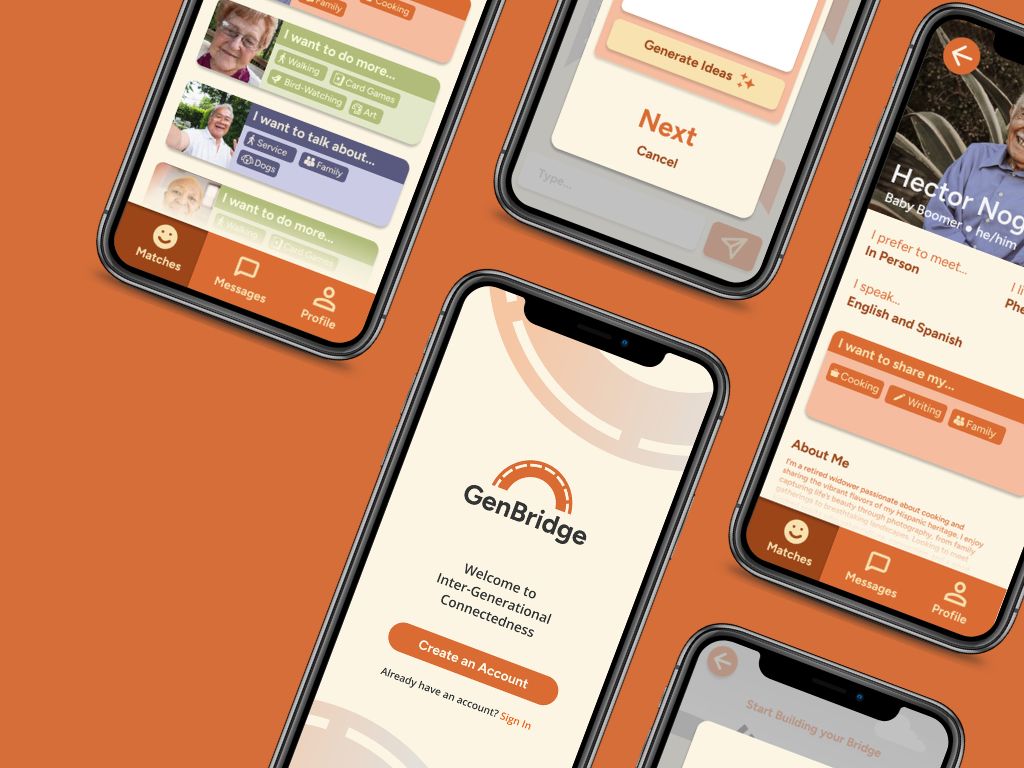
Robert Putnam's Bowling Alone warned decades ago that the fabric of American social life was quietly unraveling, and older adults are bearing the heaviest cost. A multidisciplinary team of industrial design, medical science, and computer science students spent four months in primary research, including ethnographic ride-alongs with EMS first responders, uncovering the human reality behind the statistics. What emerged was GenBridge, an intergenerational connection platform that moves beyond one-time introductions to build lasting relationships through shared interests, AI-recommended activities, and milestone tracking. The goal was never just an app, it was a system designed to restore the kind of sustained human connection that no healthcare spending can replace.

Social isolation among older adults has reached a public health crisis, yet existing solutions create one-time touchpoints with no continuity or lasting impact. EMS lieutenants describe "regulars" calling emergency services three times a day not for medical emergencies, but simply because they need someone to talk to.
GenBridge uses interest-based matching, AI-recommended shared activities, and milestone tracking to build lasting relationships step by step; deliberately designed outside the attention economy with no feeds, no scrolling, and no passive consumption. Unlike existing programs, each interaction builds upon the last, constructing a lasting bridge between users over time.
Presented at the Yale Healthcare Hackathon sponsored by the Yale Center for Biotechnology Innovation, GenBridge was recognized for its depth of problem framing and the rigor of its privacy and user protection model. The concept was grounded in four months of primary research including ethnographic fieldwork and EMS ride-alongs that surfaced the true human cost behind the Surgeon General's declaration of loneliness as a public health emergency.

.jpg)
.jpg)
Read the full lookbook.